
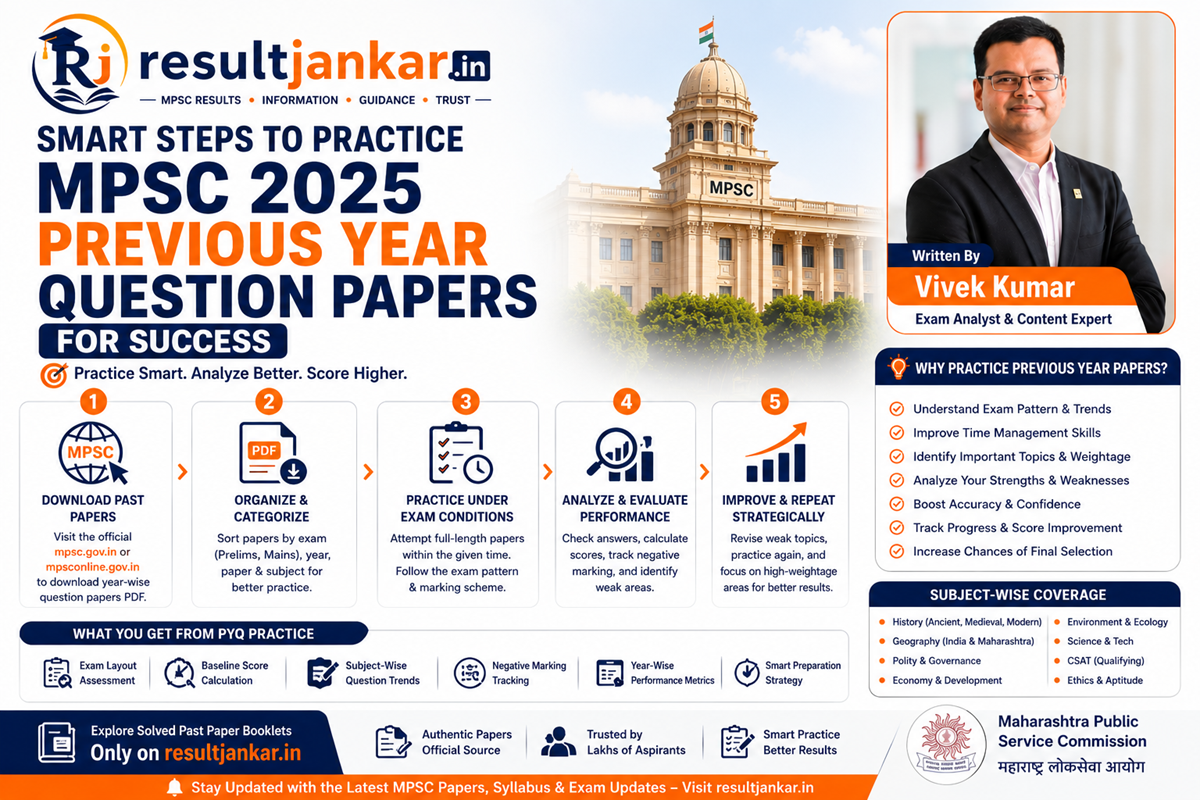
Smart Steps to Practice 2025 MPSC Previous Year Question Papers for Success
Quick Answer
To build elite speed and accuracy for state civil services, solving MPSC previous year question papers is an essential preparation milestone. The Maharashtra Public Service Commission archives official question booklets for all historical prelims and mains exam cycles. Aspirants can eliminate exam confusion and review past question trends by accessing curated collections across unified learning hubs like the Result Jankar Home Page or by directly retrieving unedited master booklets from the official MPSC Question Paper Repository.
Introduction
Stepping into the examination hall for the Maharashtra state civil services requires much more than simply memorizing thick textbooks. For thousands of dedicated aspirants across the region, true testing command comes from translating theoretical knowledge into rapid, high-accuracy decision making under strict exam hall conditions. Without practicing with actual, historical test sheets, it is easy to misjudge the difficulty level of questions and fall into unexpected negative marking traps.
Failing to analyze actual exam layouts before test day can leave you blindsided by changing question structures.
To help you optimize your practice blocks perfectly, this deep dive provides a simple, systematic approach to utilizing official MPSC previous year question papers. By combining instant data shortcuts with the core parameters enforced by the state selection board, we outline the exact steps needed to download official test sets, trace recurring subject weights, and calculate your benchmark scores with absolute confidence.
The Strategic Importance of Solving Past Booklets
Integrating historical question booklets into your weekly study timeline fundamentally changes how you process textbook information. Moving away from passive reading and embracing active question practice delivers deep advantages that directly simulate the actual testing atmosphere:
[Passive Reading] ──> Conceptual Knowledge ──> Unknown Pacing Limits ──> High Exam Day Stress
[Past Paper Practice] ──> Applied Strategy ──> Pinpoint Time Tracking ──> Controlled, Confident Execution
1. Recognizing Core Subject Weights and Trends
While the commission’s curriculum broadens over time, analyzing several years of past papers reveals clear patterns in where questions are concentrated. You will quickly observe how the commission structures its sections on Indian Polity, ancient-to-modern history with special reference to Maharashtra, regional geography distributions, and agricultural economics. This insight allows you to prioritize high-yield chapters over minor topics.
2. Mastering Real-Time Speed and Stamina Boundaries
Objective screening rounds like the Rajyaseva or Subordinate Services Preliminary tests demand rapid analytical thinking under tight time constraints. Solving older question sheets helps you train your internal clock, optimize your reading speed per item, and build the mental stamina required to stay sharp through back-to-back testing shifts.
Technical Performance Barriers to Track in 2026
Succeeding in current state service examinations requires matching past paper strategies with the latest testing formats implemented by the selection board.
Navigating the Mandatory Five-Option OMR Rules
When practicing with older question papers, it is vital to remember a key update to the testing format: all objective examinations now utilize a mandatory five-option answer layout. The fifth option serves a specific purpose—it is designed for candidates who choose to leave a question blank without guessing. If a candidate leaves a row entirely unmarked, 25% (1/4th) of the question’s allotted marks are deducted automatically. Ensure your mock sessions use updated five-option practice sheets to build the habit of marking the non-attempt bubble properly.
Managing Strict Negative Marking Parameters
For regular incorrect selections across multiple-choice blocks, the commission enforces a strict one-fourth (25%) negative marking penalty. Unattempted questions that have the fifth option marked correctly incur no points and no penalties. Practicing with older papers lets you track your guessing accuracy and learn exactly when it is smart to attempt a question and when it is better to pass.
Step-by-Step Blueprint to Practice Past Papers
Follow this practical process to securely gather your question archives, build your testing stamina, and review your performance using verified keys.
1. Monitor Curated Examination Archives
Check reliable career information hubs to find organized, year-wise test collections easily.
- Visit the homepage of Result Jankar to access a sorted stream of Maharashtra exam updates.
- Locate the Previous Year Question Papers section inside the primary navigation categories to view active test links.
- Choose your specific target track (e.g., Rajyaseva State Services or Combined Subordinate Group B) to locate relevant year-wise sets.
2. Retrieve Verified Master Booklets Straight From the Source
Download original, unedited question files directly from government servers to ensure your practice sheets remain completely accurate.
- Open your browser and navigate directly to the primary MPSC Official Website.
- Hover over the ‘Candidate Information’ menu block and click into the ‘Previous Question Papers’ directory page.
- Select the download icon corresponding to your chosen exam year to save the master PDF straight to your local drive.
3. Setup a True Simulated Exam Environment
Treat your mock practice sessions with absolute seriousness to build real test-day confidence.
- Print out physical copies of the downloaded question booklet alongside a few five-option practice OMR sheets.
- Clear your study desk of all reference books, study notes, smartphone devices, and smartwatches.
- Set a strict countdown timer matching the official paper length (e.g., 2 hours for Prelims GS Paper I).
- Solve the paper continuously without breaks, making sure to mark the mandatory non-attempt option for any questions you choose to skip.
4. Calculate Your Baseline Scores and Review Errors
Match your marked responses against official validation keys to evaluate your performance accurately.
- Open the corresponding solution file via our platform’s direct answer key directories.
- Compute your total positive score, subtract your negative marking penalties, and record your final baseline result.
- Spend at least an hour analyzing every incorrect answer, checking your reference textbooks to fix the conceptual gaps that led to the mistake.
Common Pitfalls to Avoid with Historical Test Sheets
Protect your study path from common mistakes by keeping these essential practice rules in mind.
Memorizing Past Questions Instead of Learning Concepts
Assuming that the exact same questions from previous years will repeat mechanically on your upcoming exam is a major mistake. The commission modifies its question bank constantly to test deep analytical understanding. Use past papers to study how questions are asked and which themes recur, rather than simply trying to memorize old answers.
Neglecting the Qualifying CSAT Paper Track
Focusing all your mock testing blocks exclusively on General Studies Paper I while ignoring Paper II can lead to disaster. Even if you achieve a top score on your GS paper, failing to clear the mandatory 33% qualifying threshold on the CSAT paper means your entire attempt ends instantly without your main paper even being evaluated. Dedicate consistent weekly blocks to solving historical CSAT papers.
Ignoring Your Practice Mistakes and Skipping Review Sessions
Rushing to solve dozens of past question booklets back-to-back without taking the time to review your mistakes is an inefficient way to study. A mock paper only delivers true value when you carefully analyze your errors. Skipping the review phase means you are likely to repeat the exact same conceptual mistakes on the real exam.
Comprehensive Exam Practice Matrix
The data table below breaks down how practicing historical papers helps you prepare for every stage of the state selection process.
| Question Booklet Category | Testing Format Type | Core Strategy Benefit | Suggested Practice Phase |
| Prelims Paper I (GS) | Objective Layout | Maps out recurring historical and regional geography weights | Solve 1 to 2 sets weekly during early prep |
| Prelims Paper II (CSAT) | Aptitude Focus | Trains reading speed for comprehension and data charts | Practice weekly to secure the 33% passing line |
| Subordinate Services (Group B/C) | Combined Objective | Sharpens grammar rules for Marathi and English papers | Integrate heavily during pre-exam revision weeks |
| Civil Services Mains (GS I – IV) | Comprehensive Format | Reveals core focus areas for public policy and economics | Review alongside daily descriptive note writing |
Pros and Cons of an Organized Past Paper Strategy
Pros
- Saves Vital Study Time: Helps you focus your daily revision on high-yield chapters, preventing wasted effort on retired topics.
- Builds Flawless Time Management: Simulating real exam limits trains you to complete your papers comfortably before the final bell.
- Reduces Exam Day Anxiety: Familiarizing yourself with official question formats removes last-minute panic.
- Pins Down Weak Spots: Grading your papers using official keys highlights exactly which chapters require extra study.
Cons
- Requires Pattern Adjustments: Older booklets must be adapted to match current rules, like the modern five-option OMR system.
Frequently Asked Questions
Where can I download authentic MPSC previous year question papers?
You can easily track and download year-wise past booklets in PDF format through the curated Previous Year Question Papers section on Result Jankar (resultjankar.in), which provides direct links to verified source files.
Do I need to log into a candidate profile to download old papers?
No. The state commission hosts historical question booklets as open-access public files. Anyone can view and download them without entering account passwords.
Why should I practice with past papers instead of just reading textbooks?
Textbooks provide raw knowledge, but past papers teach you how to apply that information under time pressure, identify high-yield chapters, and handle negative marking rules.
How far back should I go when solving historical MPSC papers?
Focusing deeply on the past 5 to 7 years of exam papers gives you an accurate look at modern question trends, difficulty levels, and pattern structures.
What happens if I make a mistake on an objective question?
For every incorrect choice marked on an objective question, a penalty of one-fourth (25%) of the question’s allotted marks is deducted from your overall score.
Does leaving a question completely blank trigger a penalty?
Yes, under the current format. To avoid an automatic 25% blank-row penalty, you must explicitly mark the fifth option on your OMR sheet to confirm a non-attempt.
Where can I find the correct solutions to check my mock test scores?
You can access verified solution sets and official scoring breakdowns through the dedicated internal links available across our platform layout.
Is the CSAT paper score counted toward the final preliminary merit rank?
No. Prelims Paper II is strictly qualifying. You simply need to cross the mandatory 33% minimum threshold to ensure your GS Paper I score is evaluated for merit ranking.
Can I practice descriptive mains questions using old papers?
Yes. Reviewing past descriptive papers helps you analyze how core topics like public administration, governance, and agricultural economics are structured for essay answers.
How often should an active aspirant solve full-length past papers?
During the intensive revision phase preceding your exam, solving and thoroughly analyzing 2 to 3 full-length past papers every week is a highly effective way to sharpen your skills.
Final Verdict
Analyzing official MPSC previous year question papers systematically is a vital milestone in your competitive exam journey. By stepping away from unverified study guides and using a clear, structured approach through dedicated tools like Result Jankar, you can keep your preparation timeline completely stress-free. This organized focus protects you from unexpected marking penalties and keeps your study path aligned with actual trends, letting you step into the exam hall with complete confidence.
If you are ready to expand your resource library or review historical paper trends, make the curated tools on our platform a regular stop in your prep routine. By keeping your administrative timeline perfectly organized, you can approach your studies with peace of mind and move closer to your career goals.
Technical Resources and References
Internal Links
For a deeper dive into our career tracking components, view our related breakdowns:
- 5 Practical Steps to Download Valid MPSC Admit Cards Instantly
- 5 Smart Steps to Access Scorecards and MPSC Results Safely
- The Best Guide to Latest MPSC Notifications & Exam Dates for 2026
External References
Review official examination archives, structural guidelines, and candidate notification databases directly from primary state authorities:
- Previous Question Papers Hub – Maharashtra Public Service Commission: https://mpsc.gov.in/prev_que_papers/9
- MPSC Online Candidate Registration Interface Home: https://mpsconline.gov.in/