
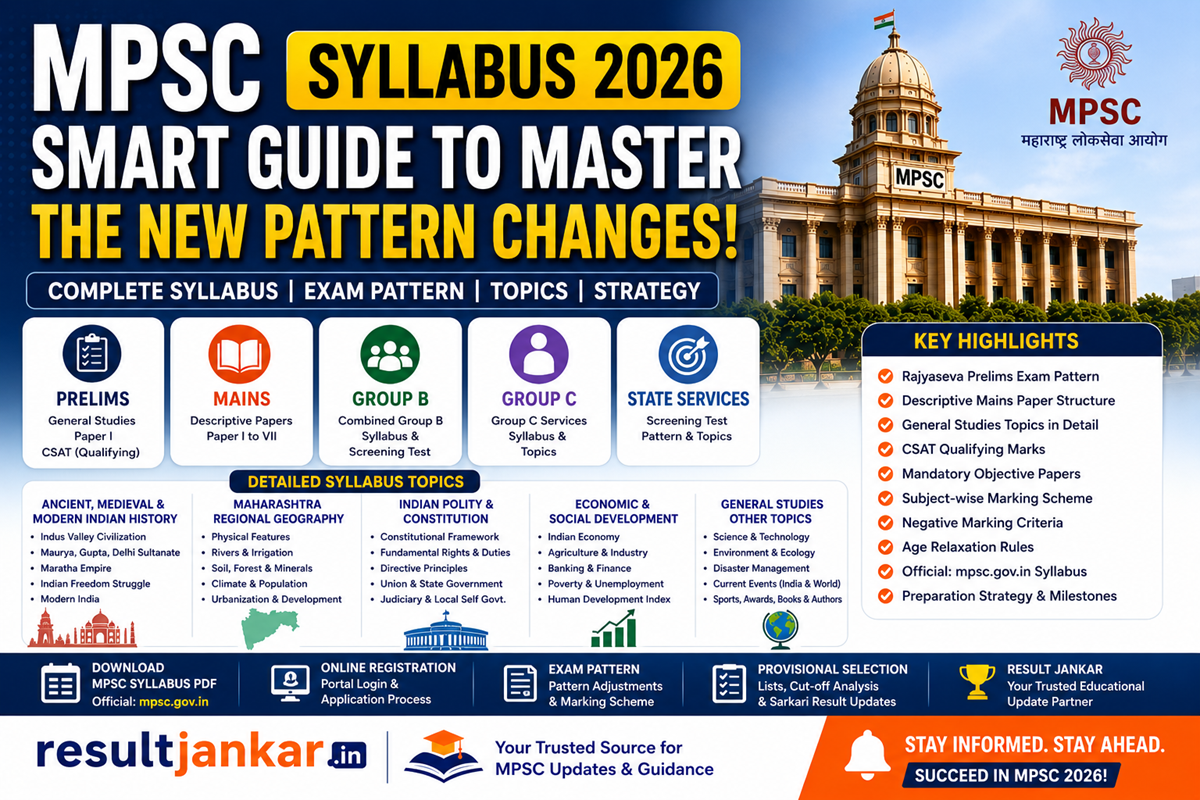
MPSC Syllabus 2026: Smart Guide to Master the New Pattern Changes
Quick Answer
To build a massive competitive advantage this calendar year, mastering the official mpsc syllabus requires analyzing its multi-tiered structure systematically. The Maharashtra Public Service Commission organizes its recruitment curriculum into distinct preliminary qualifying screens and advanced descriptive or objective main exam patterns. Major 2026 system refactors have successfully consolidated the 103 operational cadres into simplified, single-examination streams to eliminate student stress. Aspirants can eliminate exam confusion and master shifting deadlines by tracking updates across unified learning platforms like the Result Jankar Home Page or by directly downloading master files from the official MPSC Scheme of Examination Hub.
Introduction
Embarking on the journey toward securing a decorated administrative post in Maharashtra is an ambitious goal that requires intense planning. For thousands of competitive exam aspirants across the state, true preparation does not begin with blindly reading massive reference books. Instead, it begins with thoroughly understanding the official boundaries of your exam roadmap. Managing your career milestones shouldn’t feel like a confusing guessing game.
Using outdated study tracks or missing crucial pattern updates can cause you to focus on retired topics, draining your time and energy.
To help you optimize your study blocks perfectly, this deep dive provides a practical approach to navigating the official mpsc syllabus. By combining fast information shortcuts with the current standards enforced by the state selection board, we outline the exact steps needed to map out paper patterns, handle scoring rules, and set your academic preparation milestones with total clarity.
Navigating the Examination Menu Pipeline
Staying fully informed during high-stakes preparation runs becomes incredibly simple when you follow a structured sequence. Official civil service documents are arranged in a specific order to streamline your tracking process:
- Exam Notifications & Government Job Updates: The primary structural advertisements that outline initial job openings, specific reservation grids, and age parameters.
- Admit Card Releases & Answer Keys: Operational assets required to verify your local testing center coordinates, check your responses, and calculate score ranges.
- Result Announcements & Recruitment News: Post-exam processing files used to view final cut-off listings, analyze direct specialist recruitment rollouts, and review technical board policy shifts.
The Importance of Root-Level Verification
While using aggregated tracking tools saves huge blocks of daily research time, serious aspirants must maintain a reliable habit of root-level confirmation. Vital changes—such as shifting exam dates, updated eligibility criteria overview lines, or specific document dimensions—must always be double-checked directly on the official state portal before making final career decisions. This step protects your online application form from unexpected formatting or rule changes.
Core Framework of 2026 Selection Tracks
The commission divides its selection pipeline into consecutive phases to evaluate candidate knowledge, aptitude, and communication skills comprehensively. The mpsc syllabus reflects this progressive selection philosophy, testing basic foundational awareness before moving to complex administrative reasoning:
[Phase 1: Prelims Screening] ──> Objective Format ──> Tests General Aptitude & CSAT (Qualifying)
                                         │
[Phase 2: Mains Evaluation]  ──> Descriptive / Detailed Structure ──> Comprehensive Core Subjects
                                         │
[Phase 3: Personality Board] ──> Face-to-Face Interview ──> Final Merit Recommendation
1. The Civil Services Gazetted Combined Track (Rajyaseva)
The premium administrative layer serves as the gateway to the state’s elite leadership roles, recruiting for titles like Deputy Collector and Deputy SP.
- Preliminary Stage (Qualifying): Features Paper I (General Studies—100 questions, 200 marks) and Paper II (CSAT—80 questions, 200 marks). CSAT operates strictly as a qualifying barrier requiring a 33% minimum threshold.
- Mains Stage (Merit Counting): Fully transitionary descriptive layout totaling 1,750 marks across 9 comprehensive papers. This includes 2 qualifying language papers (Marathi and English at 300 marks each), 1 Essay writing module (250 marks), 4 structured General Studies papers (250 marks each), and 2 specialized Optional papers (250 marks each).
2. The Group B and Group C Combined Tracks
To minimize student strain and simplify administrative execution, the state government launched sweeping procedural reforms.
- Single Screening Gates: Cadres are organized into structured technical and administrative groups to implement single unified examinations.
- Interview Exemptions: Oral personality checks are entirely abolished for Group B (Non-Gazetted) and Group C paths, allowing final selections to rest purely on written objective merit scores.
Crucial Structural Rules to Track
Succeeding in current examination cycles means staying aware of major administrative adjustments implemented by the commission to increase transparency and discipline.
The Mandatory Five-Option OMR Rules
Applicable across all objective multiple-choice exams, every question now displays five options instead of four. Selecting an option is completely mandatory. The fifth option is designed for candidates who choose to leave a row blank without guessing. If an applicant completely skips a row without marking any option, 25% (1/4th) of the marks assigned to that question will be deducted automatically.
Standard Negative Marking Rules
For regular incorrect selections marked on multiple-choice sheets, the commission enforces a strict one-fourth (25%) negative marking scheme. Blank rows that have the fifth option filled correctly incur no penalty.
Step-by-Step Blueprint to Analyze the Curriculum
Follow this practical process to gather your subject files, structure your study tracks, and verify your progress through official channels.
1. Monitor Fresh Syllabus Alerts
Check trusted job information portals to review recent subject adjustments before organizing your books.
- Visit the homepage of Result Jankar to view a clean stream of Maharashtra competitive updates.
- Navigate directly to the Syllabus directory to locate active tracking links.
- Identify your specific target exam track to isolate the correct topic breakdown.
2. Download the Verified Master PDF Documents
Download the official curriculum lists straight from the government servers to ensure your preparation matches current requirements.
- Open your browser and navigate directly to the primary MPSC Website.
- Navigate to the ‘Candidate Information’ menu block and open the ‘Syllabus of Examination’ tab.
- Click the download icon next to your exam name to save the updated PDF guide straight to your local drive.
3. Separate Your Preliminary and Mains Target Goals
Divide your study milestones logically into screening filters and score-generating modules.
- Isolate the topics for Prelims Paper I, dedicating clear daily study slots to history, geography, polity, economics, environment, and general science.
- Incorporate regular weekly blocks practicing compression and logic reasoning to clear the CSAT barrier safely.
- Build parallel descriptive note maps for your mains papers, ensuring your modules highlight Maharashtra’s specific regional updates and constitutional provisions.
Common Pitfalls Aspirants Must Avoid
Protect your preparation timeline from common administrative errors by keeping these exam-stage pitfalls in mind.
Entering Inaccurate Data Values Inside Your Profile
Entering incorrect graduation percentages or selecting the wrong community category options just to complete a form quickly can cause serious issues later. Even if you clear the high cut-off scores of the written phases, any mismatch between your form data and your physical certificates will lead to immediate disqualification during document verification. Treat every profile entry with absolute accuracy.
Treating CSAT Qualifying Papers with Careless Neglect
Assuming that Prelims Paper II requires no practice because it is a qualifying test can be a costly mistake. If your score falls short of the mandatory 33% threshold in the CSAT paper, your General Studies paper will not even be evaluated, ending your attempt instantly regardless of how well you performed on Paper I.
Comprehensive Exam Curriculum Blueprint
The data matrix below breaks down how different official tracking resources work together to guide your preparation.
| Exam Phase Tier | Primary Subject Coverage | Test Format Style | Vital Scoring Rule |
| Prelims Paper I | General Science, History, Polity, Geography, Economy | Objective (100 Questions) | 25% negative penalty for wrong answers |
| Prelims Paper II | CSAT, Logical Reasoning, Basic Numeracy | Objective (80 Questions) | 33% qualifying threshold required |
| Combined Group B & C | General GK, Ability Testing, Language Modules | Pure Objective Layouts | Interview steps completely abolished |
| Rajyaseva Mains | Essay, 4 General Studies, 2 Optional Modules | Descriptive Format | Marks count directly for final rank |
Pros and Cons of an Organized Syllabus Strategy
Pros
- Saves Vital Study Time: Keeps your daily prep focused entirely on active tracks that will actually appear on the test, eliminating wasted effort.
- Eliminates Deadline Risks: Keeps rolling application timelines, fee structures, and pattern adjustments clearly organized, preventing missed windows.
- Builds Clear Milestone Targets: Separates your preparation seamlessly into clear prelims screening blocks and score-generating mains plans.
Cons
- Requires Constant Updates: High-stakes pattern changes or government requisitions mean you must check official resources periodically to ensure total accuracy.
Frequently Asked Questions
Where can I check the official MPSC syllabus without delay?
You can easily track all current exam guidelines, paper patterns, and post vacancies through the curated Syllabus section on Result Jankar (resultjankar.in), matching the system navigation layout.
What is the passing mark required for the preliminary CSAT paper?
Aspirants must secure a minimum qualifying threshold of 33% on Prelims Paper II to ensure their General Studies paper is evaluated for selection rankings.
How does the negative marking scheme apply to wrong answers?
For every incorrect selection marked on an objective question, one-fourth (25%) of the allotted marks for that item are deducted from your total score.
What happens if I leave an objective question completely blank?
Under the current format, failing to fill an option triggers an automatic blank-row penalty, causing a 25% points deduction unless the designated fifth option is explicitly marked.
What major change was implemented for Group B and Group C posts?
The state government has completely abolished oral interviews for all Group B (Non-Gazetted) and Group C services, routing final selections purely through written scores.
Is there an optional subject paper requirement under Rajyaseva Mains?
Yes, the descriptive main exam layout includes two optional papers valued at 250 marks each, counting directly toward final merit rankings.
Do I need to enter secure candidate log details to download the syllabus PDF?
No. The commission hosts general curriculum updates and exam patterns as open-access public files that anyone can save without entering profile passwords.
What subjects are covered inside the standard general studies prelims?
Prelims Paper I covers current events, Indian and Maharashtra history, regional geography, environmental ecology, basic economics, and general science.
Are the question booklets available in regional languages?
Yes, the test papers are generally printed bilingually in both English and Marathi, except for sections specifically testing language proficiency.
How often does the commission issue major changes to its patterns?
Schedules and formats adapt based on structural government resolutions and ministry directives. Checking Result Jankar two to three times a week keeps you fully updated.
Final Verdict
Analyzing the mpsc syllabus systematically is the critical first step toward clear, structured exam preparation. By stepping away from unverified study tracks and using an organized approach via dedicated tools like Result Jankar, you can keep your preparation timeline completely stress-free. This systematic focus protects you from unexpected marking penalties and ensures your study plan aligns perfectly with current requirements, allowing you to walk into the examination room with complete confidence.
If you are ready to review recent subject matrices or check current exam pattern adjustments, make the curated tools on our platform a regular stop in your prep routine. By keeping your administrative timeline perfectly organized, you can approach your studies with peace of mind and move closer to your goal of serving the public.
Technical Resources and References
Internal Links
For a deeper dive into our career tracking components, view our related breakdowns:
- 5 Practical Steps to Download Valid MPSC Admit Cards Instantly
- 5 Smart Steps to Access Scorecards and MPSC Results Safely
- The Best Guide to Latest MPSC Notifications & Exam Dates for 2026
External References
Review official notification logs, structural changes, and candidate system frameworks directly from primary state authorities:
- Maharashtra Public Service Commission Official Schemes Hub: https://mpsc.gov.in/examination_scheme/17
- MPSC Main Web Application Portal Candidate Dashboard: https://mpsconline.gov.in/
- Maharashtra Civil Services Gazetted Combined Preliminary Examination 2026 Notification: https://topperteachers.com/mpsc-rajyaseva-recruitment-2026-notification/
- MPSC State Services & Combined Exams Guide: https://theprayasindia.com/mpsc-state-services-combined-exams-2026-27/
- MPSC Group B Exam Dates & Vacancy Updates: https://www.adda247.com/exams/maharashtra/mpsc-group-b/
- MPSC 2026 Timetable & Exam Schedule Analysis: https://www.pw.live/state-psc/exams/mpsc-exam-date-2026