
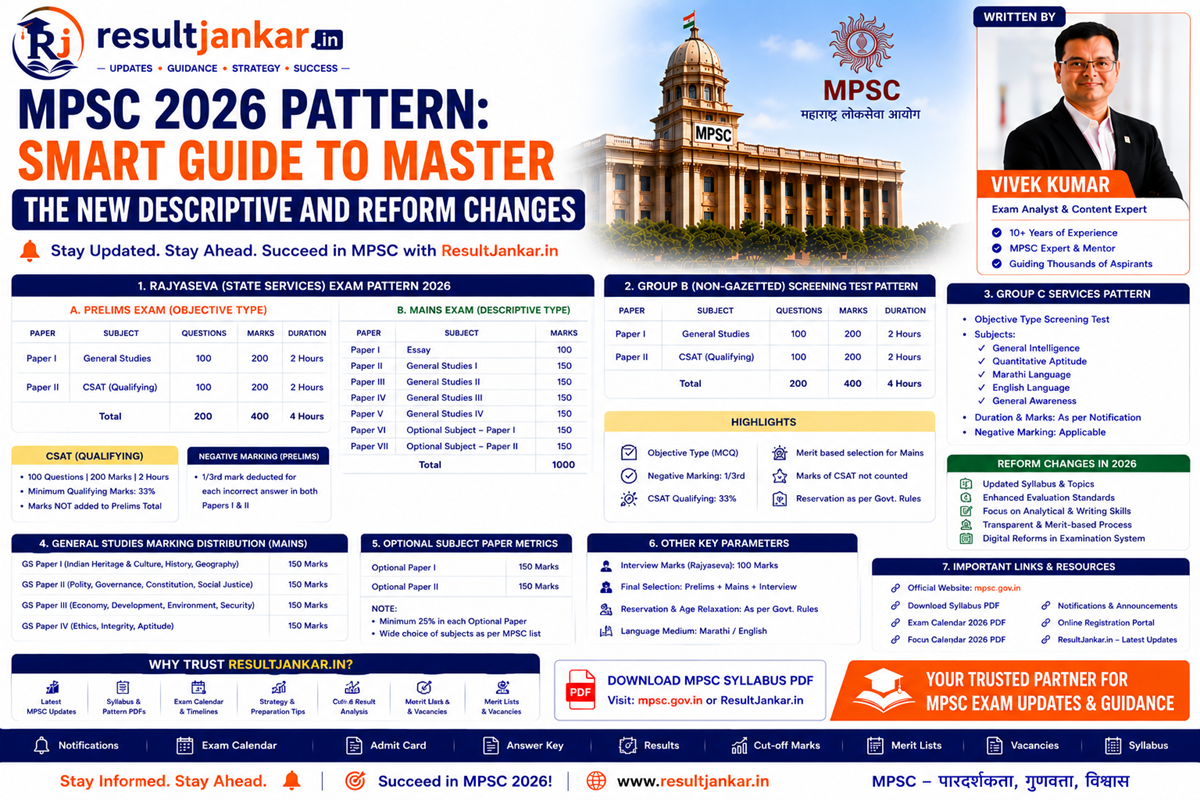
MPSC 2026 Pattern: Smart Guide to Master the New Descriptive and Reform Changes
Quick Answer
To build an absolute competitive advantage, mastering the MPSC 2026 pattern requires understanding a highly analytical, multi-stage framework. For premium Group A and B Gazetted positions (Rajyaseva), the commission implements a three-tier selection process: an objective Preliminary screening test (400 marks), a detailed UPSC-aligned Descriptive Main written examination (1,750 marks), and a final Personality Test (275 marks). Concurrently, massive administrative structural reforms have completely abolished oral interview steps for Group B non-gazetted and Group C posts, making selections for those paths fully exam-based. Aspirants can track pattern adjustments seamlessly across unified learning hubs like the Result Jankar Home Page or download official syllabus breakdowns straight from the MPSC Exam Scheme Portal.
Introduction
Stepping out onto the path toward a decorated administrative career in Maharashtra is a highly rewarding yet intensely challenging pursuit. For thousands of dedicated civil services test-takers across the state, preparation does not begin with opening heavy textbooks or memorizing facts. Instead, true mastery begins with thoroughly understanding the boundaries of your exam’s structural footprint.
Relying on outdated study templates or old, objective-style note models can cause severe strategic failures.
To help you align your daily revision routines with pinpoint precision, this comprehensive manual provides a practical deep dive into the active MPSC 2026 pattern. Pairing direct personal portal walkthroughs with the current statutory regulations enforced by the state selection board, we outline how to break down the descriptive mains matrix, handle complex scoring rules, and track streamlined selection reforms with total clarity.
Navigating the Examination Menu Pipeline
Staying fully informed during high-stakes preparation runs becomes incredibly simple when you follow a structured sequence. Official civil service documents are arranged in a specific order to streamline your tracking process:
- Exam Notifications & Vacancy Updates: The primary structural advertisements that outline initial job openings, specific reservation grids, and age parameters.
- Admit Card Releases & Answer Keys: Operational assets required to verify your local testing center coordinates, check your responses, and calculate score ranges.
- Result Announcements & Recruitment News: Post-exam processing files used to view final cut-off listings, analyze interview call rosters, and review structural pattern updates.
The Importance of Root-Level Verification
While using aggregated tracking tools saves huge blocks of daily research time, serious aspirants must maintain a reliable habit of root-level confirmation. Vital changes—such as shifting exam dates, updated eligibility criteria overview lines, or specific document dimensions—must always be double-checked directly on the official state portal before making final career decisions. This step protects your online application form from unexpected formatting or rule changes.
Stage 1: Preliminary Examination (Screening Framework)
The first stage of the MPSC 2026 pattern serves purely as a qualifying gateway designed to filter the competitive cohort into shortlisted pools for the intensive mains tier.
[MPSC 2026 Prelims Gate] ──> Paper I: General Studies (200 Marks) ──> Determines Merit Ranks
                          ──> Paper II: CSAT Aptitude (200 Marks) ──> Qualifying Barrier (33%)
1. Paper I — General Studies (200 Marks / 100 Questions)
- Core Mechanics: Candidates tackle 100 multiple-choice questions over a strict 2-hour window.
- Content Pillars: Focuses heavily on Indian Polity and Governance, Indian and Maharashtra History, Physical and Human Geography, Economic Development, and general environmental science modules. Your performance in this specific paper alone determines whether you clear the category cutoffs to proceed further.
2. Paper II — Civil Services Aptitude Test (200 Marks / 80 Questions)
- The Qualifying Hurdle: CSAT operates strictly as a non-merit screening element. Candidates must hit a mandatory qualifying threshold of 33% (66 out of 200 marks).
- Consequence of Failure: If your CSAT performance falls below the 33% line, your General Studies answers will not be evaluated for ranking, ending your attempt automatically.
Stage 2: Main Examination (The Descriptive Paradigm)
The absolute core of the competitive ranking architecture changes with the descriptive written phase. This tier demands analytical clarity, rapid answer-writing speeds, and deep subject conceptualization.
Language Qualifying Barriers (Non-Merit Counting)
Before counting your core merit scores, the commission evaluates your proficiency in two mandatory, 3-hour language descriptive papers valued at 300 marks each:
- Paper 1: Marathi Language Evaluation
- Paper 2: English Language Evaluation
Both modules require a mandatory 25% passing score. Failing to clear the language papers means your General Studies and Essay marks will remain permanently locked and uncounted.
Merit Counting Papers (1,750 Marks Total)
Once language criteria are met, final written merit rankings depend entirely on a 7-paper descriptive layout graded at 250 marks apiece:
- Paper III (Essay): Requires drafting two comprehensive essays from a choice of various topics.
- Paper IV (General Studies I): Covers history, geography, and socio-cultural structures with deep emphasis on Maharashtra’s regional context.
- Paper V (General Studies II): Focuses heavily on the Constitution, Indian Polity, Governance systems, and administrative networks.
- Paper VI (General Studies III): Investigates Human Resource Development (HRD) and Human Rights parameters.
- Paper VII (General Studies IV): Tests proficiency across Economy, Technology, Science, and Environmental security protocols.
- Papers VIII & IX (Optional Subject Papers I & II): Candidates select a single specialized optional discipline from an official roster, writing two advanced graduate-level descriptive papers.
Personal Experience: Navigating My Portal and Score Tracking
To show you exactly how the technical interface operates during live result and schedule updates, here is my direct experience navigating the candidate dashboard space:
1. Bypassing Main Server Congestion
When the commission rolls out fresh circulars or answer matrices, accessing the open home page links frequently leads to database response errors. I systematically bypass these loops by bookmarking and connecting directly to the secure terminal at mpsconline.gov.in. I enter my registered email identity string and password, solve the security CAPTCHA verification layout, and access my private profile space.
2. Monitoring My Active Scheme Tabs
Inside my candidate workspace, I navigate to the left-hand menu tree and select the ‘Syllabus / Exam Scheme’ option block. The portal dynamically displays your active application tracks (such as the Gazetted Combined Examination ledger). This isolated interface lets me download updated master instructions regarding answer booklet structures, margin alignment limits, and word-count boundaries as crisp PDFs straight to my device, keeping my weekly preparation completely accurate.
Case Study: Student Adaptability Blueprint
Analyzing real candidate journeys demonstrates how shifting from old, objective rote-learning patterns toward deep, analytical structures determines success under current frameworks.
Candidate Profile: Swapnil R. (Panvel Region)
- The Tactical Dilemma: Swapnil spent three years memorizing brief one-line facts tailored for traditional objective tests. When the commission finalized the descriptive layout re-alignment, his massive stock of memorized details failed to translate into coherent, multi-paragraph essays or public policy analyses.
- The Correction Roadmap: For the 2026 cycle, Swapnil completely redesigned his daily study blocks. He integrated a 90-minute daily writing window—summarizing regional Maharashtra economic budgets and constitutional amendments into structured answers containing an introduction, core analytical arguments, and a clear conclusion.
- The Result Metrics: This analytical structural adjustment allowed him to clear his practice mock test benchmarks with ease, demonstrating that script clarity and structured arguments matter far more than bulk factual recall.
Step-by-Step Blueprint to Master the 2026 Pattern
Follow this straightforward process to structure your study trackers, synchronize your library, and optimize your preparation milestones.
1. Isolate Curated Information Dashboards
Check reliable career curation platforms to easily capture fresh selection lists and syllabus adjustments as soon as they are announced.
- Visit the homepage of Result Jankar to view an organized stream of Maharashtra civil service updates.
- Navigate straight to the Syllabus row to read organized summaries of marking patterns and optional rosters.
2. Download Master Syllabus Assemblies
Pull authentic, unedited blueprint PDFs straight from primary state files to align your textbooks correctly.
- Navigate to the official government server interface at MPSC Hub.
- Open the ‘Candidate Information’ menu block and click into the ‘Syllabus of Examination’ tab.
- Download the detailed instructions for both the Gazetted Descriptive Mains and Combined Non-Gazetted tracks.
3. Implement Balanced Answer-Writing Blocks
Divide your weekly routine into conceptual reading and physical, timed descriptive writing practices.
- Dedicate mornings to building conceptual clarity in Polity and History using standard reference textbooks.
- Dedicate evenings to practicing answer generation under timed conditions on plain, unruled A4 paper.
- Incorporate regular weekly blocks practicing reading comprehension passages to secure your 33% CSAT qualifying barrier smoothly.
Common Pitfalls Aspirants Must Avoid
Protect your preparation timeline from common strategic errors by keeping these critical pitfalls in mind.
Entering Inaccurate Data Values Inside Your Profile
Entering incorrect graduation percentages or selecting the wrong community category options just to complete a form quickly can cause serious issues later. Even if you clear the high cut-off scores of the written phases, any mismatch between your digital form data and your physical certificates will lead to immediate disqualification during document verification. Treat every profile entry with absolute accuracy.
Treating Descriptive Writing as a Casual Post-Prelims Goal
Assuming that you can comfortably build comprehensive answer-writing skills during the brief window between the Preliminary exam and the Main written examination is a massive mistake. Developing a structured, balanced writing style that cleanly incorporates data matrices, diagrams, and clear summaries requires months of disciplined, daily practice. Start practicing your writing from day one.
Comprehensive Examination Layout Matrix
The detailed table below outlines the structural layout of the current selection framework.
| Exam Phase Tier | Number of Papers | Maximum Marks | Question Format Style | Core Merit Role |
| Preliminary Stage | 2 Papers (GS + CSAT) | 400 Total Marks | Pure Objective (MCQ) | Qualifying screen only; does not count for final rank |
| Mains Language Barrier | 2 Papers (Marathi + English) | 600 Total Marks | Detailed Descriptive | Mandatory qualifying gate (25% required) |
| Mains Core Merit | 7 Papers (Essay + GS + Optional) | 1,750 Total Marks | Detailed Descriptive | Determines your final civil service merit rank |
| Personality Phase | Oral Board Interview | 275 Total Marks | Face-to-Face Interview | Added to written merit for final job allocation |
Pros and Cons of the Descriptive Pattern Alignment
Pros
- Creates a Level Playing Field: Aligning closely with central civil service (UPSC) frameworks allows candidates to prepare for both exams simultaneously with a single, unified strategy.
- Rewards Analytical Depth: Moving away from rote-memorization templates ensures that conceptual understanding and logic reward serious aspirants.
- Reduces Exam Duplication: Streamlining recruitment rules and consolidating similar cadres helps reduce overall stress and exam duplication.
Cons
- Demands Significant Time: Mastering high-speed answer creation across nine separate papers requires a long-term, highly disciplined study routine.
Frequently Asked Questions
Where can I check the complete MPSC 2026 pattern guidelines without delay?
You can easily track all current exam frameworks, layout blueprints, and core subject breakdowns through the curated Syllabus directory on Result Jankar (resultjankar.in).
Is the preliminary CSAT paper counted toward the final merit list?
No. Paper II (CSAT) operates strictly as a qualifying filter requiring a 33% minimum threshold (66 out of 200 marks). Your preliminary rank depends entirely on your Paper I (General Studies) marks.
How many optional subject papers are required under the Rajyaseva Mains?
The descriptive main exam pattern features two mandatory optional papers (Paper VIII and Paper IX) focused on a single selected discipline, carrying 250 marks each.
What is the negative marking penalty enforced for objective papers?
Depending on the specific exam sub-track, a strict negative marking penalty of one-fourth (1/4th) or one-third (1/3rd) of the allotted marks is deducted for every incorrect choice.
Have oral interviews been removed for Group B and Group C services?
Yes. Under recent state government reforms, personality interviews have been removed entirely for Group B non-gazetted and Group C posts, making selections fully exam-based.
What is the required passing mark for the Mains qualifying language papers?
Candidates must secure a minimum qualifying score of 25% in both the Marathi and English language papers to ensure their merit papers are evaluated.
Can I choose to write my descriptive main papers in regional languages?
Yes. Except for specific language test sections, candidates have the choice to answer their descriptive papers in either Marathi or English.
Do I need secure candidate profile credentials to download the syllabus PDF?
No. The commission hosts general examination schemes, marking patterns, and detailed curriculum parameters as open-access files available to anyone without logging in.
What subjects are covered within the four General Studies mains papers?
The papers cover History and Geography (GS I), Constitution and Polity (GS II), Human Resource Development (GS III), and Economy, Science, and Technology (GS IV).
How frequently should an active candidate review updates on our platform?
Checking our aggregated tracking categories two to three three times a week ensures you stay well ahead of live timetable adjustments, key releases, and portal updates.
Final Verdict
Analyzing the MPSC 2026 pattern systematically is the critical first step toward clear, structured exam preparation. By stepping away from unverified study tracks and using an organized approach via dedicated tools like Result Jankar, you can keep your preparation timeline completely stress-free. This systematic focus protects you from unexpected marking penalties and ensures your study plan aligns perfectly with current requirements, allowing you to walk into the examination room with complete confidence.
If you are ready to review recent subject matrices or check current exam pattern adjustments, make the curated tools on our platform a regular stop in your prep routine. By keeping your administrative timeline perfectly organized, you can approach your studies with peace of mind and move closer to your goal of serving the public.
Technical Resources and References
Internal Links
For a deeper dive into our career tracking components, view our related breakdowns:
- 5 Practical Steps to Download Valid MPSC Admit Cards Instantly
- 5 Smart Steps to Access Scorecards and MPSC Results Safely
- The Best Guide to Latest MPSC Notifications & Exam Dates for 2026
External References
Review official notification logs, structural changes, and candidate system frameworks directly from primary state authorities:
- Maharashtra Public Service Commission Schemes Matrix Hub: https://mpsc.gov.in/examination_scheme/17
- MPSC Main Web Application Portal Candidate Dashboard: https://mpsconline.gov.in/
- Maharashtra Civil Services Gazetted Combined Preliminary Examination 2026 Notification: https://topperteachers.com/mpsc-rajyaseva-recruitment-2026-notification/
- MPSC State Services & Combined Exams Guide: https://theprayasindia.com/mpsc-state-services-combined-exams-2026-27/
- MPSC Group B Exam Dates & Vacancy Updates: https://www.adda247.com/exams/maharashtra/mpsc-group-b/
- MPSC 2026 Timetable & Exam Schedule Analysis: https://www.pw.live/state-psc/exams/mpsc-exam-date-2026